

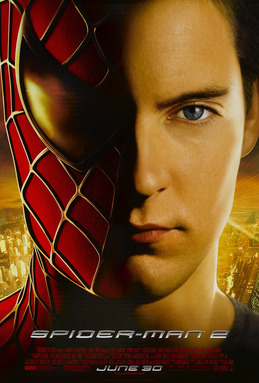
(image obtained from Wikipedia)
Spider-Man 2 follows Peter Parker as he struggles to balance college, work, relationships, and his secret life as Spider-Man. Overwhelmed by responsibility and personal failure, Peter begins losing his powers and believing he can’t handle the weight of being a hero, he quits.
Meanwhile, scientist Otto Octavius becomes the villain Doctor Octopus after a failed experiment fuses mechanical arms to his body. As danger rises, Peter realizes he cannot escape his calling, embracing the truth that with great power comes great responsibility.
Take a look at this clip from the movie obtained from YouTube:
When he had finished speaking, he said to Simon, “Put out into deep water, and let down the nets for a catch.” Simon answered, “Master, we’ve worked hard all night and haven’t caught anything. But because you say so, I will let down the nets.” When they had done so, they caught such a large number of fish that their nets began to break. So they signaled their partners in the other boat to come and help them, and they came and filled both boats so full that they began to sink. When Simon Peter saw this, he fell at Jesus’ knees and said, “Go away from me, Lord; I am a sinful man!” For he and all his companions were astonished at the catch of fish they had taken, and so were James and John, the sons of Zebedee, Simon’s partners. Then Jesus said to Simon, “Don’t be afraid; from now on you will fish for people.” So they pulled their boats up on shore, left everything and followed him.
Luke 5: 4-11
You ever have a moment that was supposed to be a win, but it wrecked you instead? Not in a bad way. In a ‘this changes everything‘ way. That’s Peter in Luke 5. That’s the part of the Gospel nobody puts on a motivational poster. Peter’s reaction to Jesus wasn’t hype. It wasn’t, “Bro did you see all those fish?!” It was collapse. After the miracle, the nets almost breaking, the kind of moment you’d post with three fire emojis — he hits his knees and basically says, “I don’t deserve to be this close to You.” Not flexing. Not celebrating. Just, “I’m a sinful man.”
Honestly, it makes sense because the closer you get to light, the more clearly you see the dust. When perfection stands in front of imperfection, clarity happens fast. We see it throughout scripture. When Isaiah saw the Lord high and lifted up, he said, “Woe is me.” When Job encountered God’s majesty, he repented in dust and ashes. Self-confidence evaporates when holiness reveals itself. Peter sees the miracle and suddenly understands both who Jesus is and who he (Peter) is. That’s grace! It produces self-awareness.
When grace gets real, it doesn’t inflate you. Your first instinct isn’t applause. Peter’s response teaches us something deeply practical: transformation begins with accurate self-awareness. Not shame that spirals into despair, but conviction that leads to surrender. You start replaying your life like a highlight reel you don’t want anyone to see. Then you look at the cross as if to ask: Why would God step into my mess? Why would an Almighty, cosmic Creator stoop down into our timeline? The problem isn’t that we think too little of ourselves; it’s that we think too little about the holiness of God. And yet, here’s the crazy part — Jesus doesn’t step back. He steps closer.
“Nearly all the wisdom we possess consists of two parts: the knowledge of God and of ourselves.”
John Calvin
“What comes into our minds when we think about God is the most important thing about us.”
A.W. Tozer
We may never fully understand it, but understanding isn’t required for surrender. We can celebrate it. We can live like it’s true. It’s a change of allegiance. Peter moves from being self-directed to Christ-directed. And that shift is not abstract. It affects career, priorities, time, money, relationships — everything.
It’s giving Spider-Man 2 energy. In the scene above, Peter Parker drops the suit in the trash, trying to step away from the weight of calling. But in Luke’s account, fisherman Peter isn’t escaping responsibility. He’s accepting a greater one. It’s a split-second, all-in resignation from the old life. That’s what happens when you meet Jesus. You don’t negotiate terms or add spiritual fine print. You don’t say, “Let me pray about it for a decade.” No terms and conditions apply. No backup plan. Just yes.
“Give up yourself and you will find your real self.”
C.S. Lewis
Jesus has this way of interrupting the ordinary. Of calling you out of the safe storyline you’ve been building for years. And that’s where it gets uncomfortable, because we’ve invested a lot in this version of our life. Education. Career. Reputation. Comfort. Docking the boat feels irresponsible. Most of us don’t reject Jesus outright. We just keep Him adjacent. We want forgiveness without surrender. Inspiration without lordship. Eternal life without present obedience.
We tell ourselves, “It’s too late to pivot.” “I’m too established.” “I’ve already built this.” But here’s the tension: you get one life. Not a test run. Not a reboot season. One. The late Steve Jobs once challenged a corporate exec with: “Do you want to sell sugar water for the rest of your life, or come with me and change the world?” That’s a bold question. But God’s question is bigger: Do you want to maintain comfort or change eternity? That decision doesn’t just affect you. It shapes generations.
The faith you live (or avoid) echoes forward. It’s easy to drift. To stay respectable. To keep the boat docked because it’s paid off and predictable. But that’s not faith. Faith says, “If this grace is real, then my life is Yours.” It’s adventure and risk. It’s radical generosity with your time, talent, and treasure. Peter’s surrender isn’t blind. It’s reasoned faith in a God who proves Himself over and over. Peter docks the boat because he has seen enough of Jesus to trust the rest. Deep faith docks the boat. Drops the net. Leaves the suit in the trash.
“Expect great things from God; attempt great things for God.”
William Carey
“The Christian ideal has not been tried and found wanting; it has been found difficult and left untried.”
G.K. Chesterton
At some point, everyone has their moment — the evidence is on the table, the call is clear, and comfort is competing with conviction. So here’s the question: What’s your boat? What’s the thing you keep docked because it’s safe, paid off, and predictable — but you know, somewhere deep down, you were made for more? You don’t have to have it all figured out. Peter didn’t. He just said yes. Start there.