

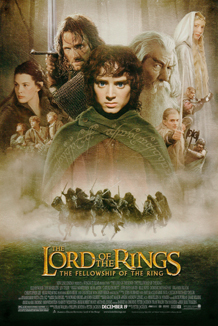
(Image obtained from Wikipedia)
The Lord of the Rings: The Fellowship of the Ring follows a young hobbit named Frodo Baggins who inherits a mysterious ring—one that turns out to be the most dangerous object in Middle-earth. The Ring holds immense power and when Frodo learns the truth, he’s given an impossible task: carry the Ring to Mount Doom, the only place it can be destroyed. Along the way, a diverse group—men, elves, dwarves, a wizard, and hobbits—form the Fellowship to help him on his journey.
As they travel, the Fellowship faces constant danger, betrayal, and temptation and the Ring repeatedly offers power, protection, and control. By the end of the film, the Fellowship is fractured, but Frodo chooses the harder path—continuing the mission alone rather than risking the corruption of those he loves.
Take a look at this clip from the movie obtained from YouTube:
Picture this: you’re standing on the edge of a cliff. Wind screaming. Heart racing. There’s a bridge…maybe. It looks solid. You hope it’s solid. And every part of you wants to sprint across instead of slowing down and checking the warning signs and the foundation. That was me a few years ago, except the cliff was a microwave and the bridge was a frozen lasagna. “I’ll skip defrost. It’ll be fine.” It was not fine! Burned edges. Frozen center. Warped plastic. Emotional damage. That’s the thing about shortcuts — they promise speed, but they usually charge interest.
That’s exactly how temptation works — including when Satan tempted Jesus. Christians hold onto this hope: Jesus will reign. His kingdom is coming. His victory is guaranteed. That wasn’t a surprise — it was promised centuries before He ever walked the earth. Now keep that in mind when we look at Satan’s third temptation of Jesus.
Again, the devil took him to a very high mountain and showed him all the kingdoms of the world and their glory. And he said to him, “All these I will give you, if you will fall down and worship me.” Then Jesus said to him, “Be gone, Satan! For it is written, You shall worship the Lord your God and him only shall you serve.”
Matthew 4:8-10 (English Standard Version)
Think about the Lord of the Rings movie clip. When Frodo offers Gandalf the Ring, it seems reasonable. Gandalf is wise. Powerful. Moral. If anyone could use the Ring for good, it would be him. But Gandalf refuses—hard! Why? Because this moment exposes a deep truth about human nature: power doesn’t just amplify good intentions—it corrupts them. Gandalf doesn’t say no because the Ring is useless. He says no because it works too well. Power without surrender. Victory without faithfulness. Good intentions — corrupted by the wrong path. That aligns with a core biblical idea: even righteous people aren’t immune to temptation.
Don’t think for one second that Jesus wasn’t really tempted or couldn’t be. His divinity didn’t cancel His humanity. Jesus experienced hunger, exhaustion, emotional strain, and the natural human desire to avoid suffering. That’s what made Satan’s offers powerful. With this third temptation, when Satan offers Jesus the kingdoms of the world, he isn’t offering something fake. He’s offering Him something real. Something already promised. The kingdoms of the world were always going to belong to Jesus. So where’s the temptation? It’s the shortcut!
Satan’s pitch is basically: “You can rule now. You can skip the suffering. You can take the crown without the cross.” In other words: God’s promise — but faster, easier, and disobedient. Same strategy. Different century. Satan’s pitch is always the same: You deserve this—just not God’s way. And honestly, that strategy still works. Satan doesn’t usually tempt us with obvious evil. He tempts us with good things, promised things, even God-given things — but obtained the wrong way. We see this pattern everywhere, whether it’s leaders cutting corners for short-term gains or societies chasing quick fixes instead of lasting solutions. We saw it with the prodigal son (Luke 15:11-24). The inheritance was coming but impatience said, “I want it now.” Speed over trust. Outcome over obedience.
“The greatest temptation Jesus faced was not pain, but the chance to have the kingdom without the cross.”
John Piper
“The temptation lay not in the promise of power itself, but in the unlawful means of obtaining it.”
A.W. Pink
The result of yielding to temptation isn’t just bad people doing bad things— it’s decent people being slowly twisted by power, pride, and self-justification. Gandalf understands that the Ring doesn’t just offer control—it reshapes the heart. You might start by saying, “I’ll use this to protect people,” but slowly it becomes, “I know what’s best,” then “I deserve this power,” then “I am the authority.”
That’s basically a visual metaphor for sin and idolatry. Taking something powerful and letting it replace God as the source of control, identity, or security. Most of us think idolatry means statues, golden calves and ancient rituals, but it’s way more subtle. Idolatry happens when a good gift becomes a god. When we want the blessing more than the One who blesses. When we want the crown more than we want God’s will. For Jesus, ruling over the kingdoms of the world is a good thing. But pursuing that good thing apart from the Father’s will would’ve been wrong. So Jesus responds the way Gandalf does—by refusing the shortcut. He anchors Himself in truth and says, quoting Deuteronomy 6:13: “Worship the Lord your God and serve only Him.” Jesus wasn’t chasing power, popularity, or an easy win. If He were a fraud, He would’ve taken the shortcut. Instead, He chose obedience over ambition and faithfulness over fame.
Gandalf’s refusal isn’t fear—it’s humility. He recognizes a truth modern culture hates to admit: no one is morally strong enough to be their own god. That’s why humans need moral limits, divine authority, and ultimately God—because left to ourselves, even our “best intentions” aren’t enough to save us from becoming the villain.
Satan is still playing the same game today. He wants our worship, and if he can’t get it directly, he’ll gladly take it through substitutes.
Money. Sex. Authority. Status. Control. Validation
All good gifts—until they become ultimate things. When any of those take God’s place, they stop being gifts and start becoming gods. When we bow down to them, we’re not just choosing convenience—we’re choosing something other than God.
“Satan promises kingdoms, but Christ chooses obedience. The glory of the world is always offered at the cost of faithfulness to God.”
John Calvin
“The devil’s bait is dominion without duty, a crown without a cross, and a kingdom without submission to God.”
Matthew Henry
Jesus understands the struggle—because He faced it Himself. And how He handled temptations shows us a better way. No shortcuts. No compromised worship. No trading faithfulness for speed. When Jesus responded with “Worship the Lord your God and serve only Him,” it was an affirmation of God as the ultimate authority. Jesus’ loyalty was to the Father over worldly gain. Can we say the same?
Let’s be honest — nobody wakes up thinking, “Today feels like a great day to worship an idol.” Idolatry usually looks normal. Responsible. Ambitious. Relatable. So how do we guard our hearts in real life?

- Audit What Has Your Emotional Loyalty
- Build a Habit of Gratitude
- Submit Your Dreams to God
- Surround Yourself With People Who Call You Out
- Regularly Ask: ‘Is This a Tool or My Master?
- Follow Jesus’ Strategy: Choose Obedience Over Outcomes
Jesus didn’t resist temptation because it wasn’t real. He resisted because obedience to the Father mattered more than instant power.
Shortcuts look smart, but faithfulness wins. The kingdom is coming—but how we pursue it reveals who we worship.




This is terrific! . . . well-written and insightful! Thank you!!
God be praised!